How AI Chatbot Integration Is Transforming Business Applications

Summary
Discover how AI chatbot integration is reshaping business applications by automating tasks, improving customer interactions, and boosting efficiency. This blog explains key benefits, real-world use cases, future trends, and expert insights to help you understand why integrating AI chatbots is the next big step for future-ready businesses.


The New Era of Business Conversations

In today’s fast-moving digital world, customers expect instant responses, personalized recommendations, and seamless experiences across every touchpoint. Businesses can no longer afford to rely solely on manual interactions or long response times. That’s where AI chatbot integration is reshaping the game.
Modern chatbots are no longer simple FAQ bots. When integrated into business applications like CRM systems, ERP software, e-commerce platforms, or marketing automation tools, they become intelligent assistants that can understand intent, act on data, and deliver real value to both businesses and customers.
From improving customer engagement to automating workflows, AI chatbot integration is helping organizations work smarter, scale faster, and grow consistently.


What Exactly Is AI Chatbot Integration?

What is AI Chatbot Integration

At its core, an AI chatbot uses machine learning and natural language processing (NLP) to understand user queries, provide contextual answers, and perform actions automatically.
But the real transformation happens when the chatbot is integrated into your existing business systems and data sources like CRMs (Salesforce, HubSpot), e-commerce platforms (Shopify, Magento), or enterprise software (SAP, Microsoft Dynamics).
Without integration, a chatbot is just an isolated communication tool. With integration, it becomes an intelligent bridge between users and business data, enabling end-to-end automation.
For example:

  • A customer support chatbot can check the order status directly from your ERP.
  • A sales chatbot can pull contact data from CRM and suggest next steps.
  • An HR chatbot can handle leave requests through your internal system.
  • This connection between conversation and data-driven action is what makes chatbot integration a game-changer for businesses.


Why Businesses Are Turning Toward Chatbot Integration

Enterprises today face challenges like increasing customer expectations, rising operational costs, and the constant need to stay responsive across multiple channels. AI chatbot integration addresses all three.
Here’s why businesses across industries are investing in this technology:

  • Operational Scalability: Handle thousands of conversations simultaneously without hiring more staff.
  • Efficiency: Reduce human workload and eliminate repetitive tasks.
  • Personalization: Deliver contextual responses based on real-time data.
  • Cost Savings: Automate 60-70% of routine queries, reducing support costs dramatically.
  • Improved Lead Management: Capture, qualify, and route leads instantly to the right sales representative.

In short, for decision-makers, chatbot integration isn’t just a support upgrade; it’s a strategic investment that boosts efficiency and strengthens customer relationships.


The Key Benefits of AI Chatbot Integration
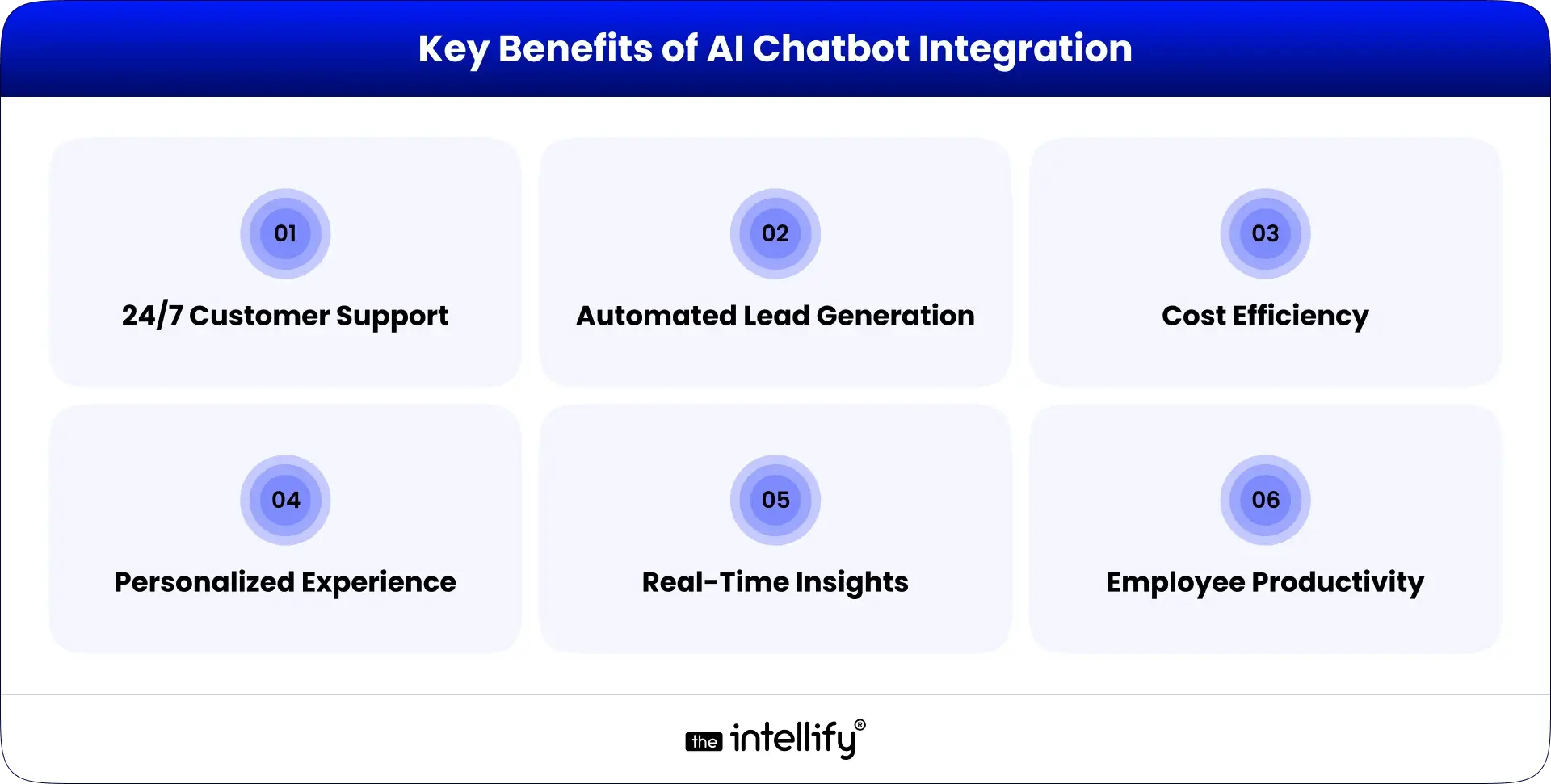
Benefits of AI Chatbot Integration

Let’s look at how integrated chatbots are transforming business operations:

1. 24/7 Customer Support

Chatbots ensure customers are never left waiting. Whether it’s a query at midnight or on a holiday, AI chatbots respond instantly, increasing customer satisfaction and loyalty.

2. Automated Lead Generation

Integrated chatbots can identify potential buyers, qualify them using predefined rules, and automatically pass them to your sales team. This leads to better conversion rates with less manual effort.

3. Cost Efficiency

By handling repetitive queries and automating simple processes, chatbots reduce the need for large support teams, saving both time and resources.

4. Personalized Experience

Integration enables access to customer history and preferences stored in CRMs, allowing chatbots to tailor recommendations and responses.

5. Real-Time Insights

Chatbots collect valuable data about customer behavior and preferences, helping businesses improve marketing campaigns and optimize customer journeys.

6. Employee Productivity

Internal chatbots help employees quickly find answers, submit requests, and stay informed by reducing dependency on HR or IT departments for routine queries.
 

AI chatbots for business


Real-World Example: Retail Chatbot Integration Success

A leading global retail brand faced rising support costs and abandoned carts. They integrated an AI chatbot with their CRM and e-commerce backend. The chatbot assisted shoppers with product discovery, price comparisons, and order tracking through real-time integration.
Within 90 Days:

  • Customer response time dropped by 45%.
  • Cart abandonment decreased by 25%.
  • Sales conversions increased by 30%.

This case proves that AI chatbots, when deeply connected with data systems, don’t just talk, they drive tangible business results.


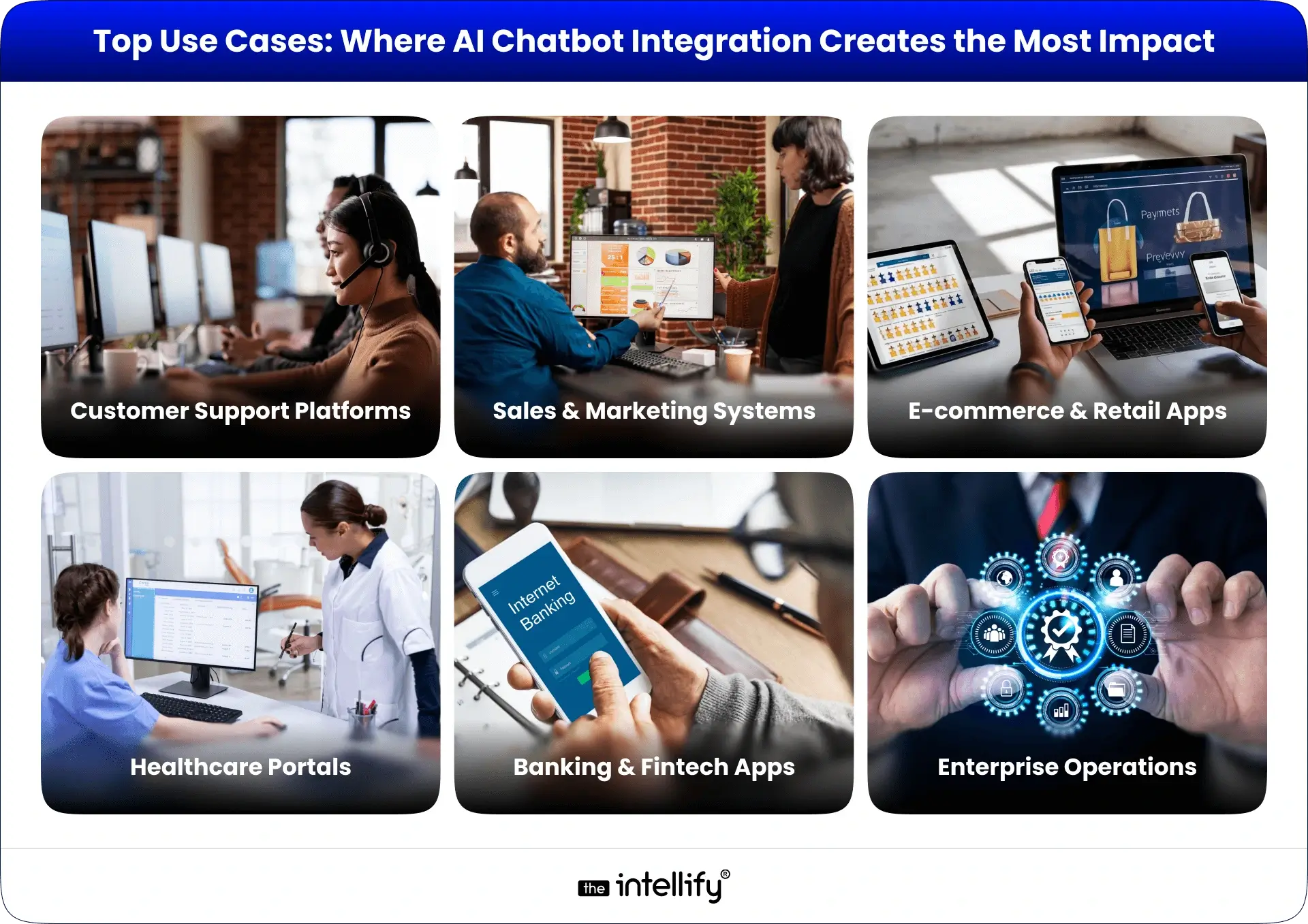
Top Use Cases: Where AI Chatbot Creates the Most Impact
AI chatbot use cases

AI chatbot integration is highly adaptable. Here are some of the most common applications across industries:

Customer Support Platforms

Integrated chatbots instantly respond to common queries, check order statuses, and create support tickets, reducing wait times and improving satisfaction scores.

Sales & Marketing Systems

Chatbots can engage website visitors, qualify leads, and even book sales appointments by syncing with your CRM or email automation tool. This creates a frictionless buyer journey from interest to conversion.

E-commerce & Retail Apps

In e-commerce, AI chatbots act as shopping assistants which recommend products, manage cart recovery, and handle post-purchase queries. Integrated bots can even track inventory or initiate reorders automatically.

Healthcare Portals

Healthcare providers use integrated chatbots for appointment booking, patient pre-screening, and medication reminders. This reduces admin overhead while improving patient access to care.

Banking & Fintech Apps

Chatbots handle secure transactions, track spending, and provide real-time updates. Integration with banking systems ensures accurate, compliant, and instant responses.

Enterprise Operations

For large enterprises, chatbots automate employee onboarding, IT support, and HR requests, while reducing manual intervention and improving efficiency.

In short, AI chatbot integration adapts to every domain, wherever there’s repetitive interaction or data-driven communication, chatbots create a measurable impact.


Process of Integrating AI Chatbots into Business Applications

AI chatbot integration process

Integrating AI chatbots is more than installing a plugin, it’s about creating a smooth digital ecosystem where conversations lead to outcomes.

Here’s how businesses can do it strategically:

  • Define the Objective: Identify what you want your chatbot to achieve, whether it’s lead generation, customer support, or workflow automation.
  • Select the Right AI Platform: Choose an AI chatbot platform that aligns with your stack, like Google Dialogflow, Microsoft Bot Framework, or IBM Watson.
  • Map Conversational Flows: Design natural and helpful dialogues that mirror real user needs.
  • Integrate with Core Business Systems: Connect APIs to CRMs, ERPs, and databases so your chatbot can fetch and update data automatically.
  • Train and Fine-Tune: Use real customer interactions to train the bot for better accuracy, tone, and context.
  • Test Thoroughly: Conduct live testing for different use cases to ensure smooth integration and quick responses.
  • Monitor and Optimize: Track performance metrics, engagement rate, resolution time, conversion rate, and keep improving over time.


Challenges to Consider While Integrating AI Chatbots

Even though chatbot integration offers huge benefits, it’s not without challenges. Here’s how to address them:

  • Complex IT Ecosystems: Use middleware or unified API connectors to simplify integration.
  • Data Privacy Concerns: Follow GDPR, HIPAA, or other relevant regulations to ensure compliance.
  • Conversational Accuracy: Continuously train and improve your bot with real-world data.
  • Measuring ROI: Define KPIs early and track measurable business impact.
  • Skill Gaps: Collaborate with experienced AI integration partners to ensure technical success.


The Future of AI Chatbots in Business Applications
Future of AI chatbot in business applications

The next evolution of chatbot technology is moving toward AI agents, intelligent systems capable of predicting needs, making decisions, and automating tasks end-to-end.
Future chatbot integrations will include:

  • Voice Interfaces: Seamless voice-enabled support across devices.
  • Generative AI: Smarter bots that create human-like responses and adapt tone dynamically.
  • Predictive Insights: Using data to anticipate customer questions or recommend next actions.
  • Omnichannel Integration: Consistent experience across web, mobile, social, and in-store channels.

As AI maturity grows, chatbots will no longer just support business operations, they’ll run parts of them autonomously.


The Intellify: Your Trusted Partner for AI Chatbot Integration

At The Intellify, we specialize in building and integrating AI chatbot solutions tailored to your unique business ecosystem.
Our team connects chatbots with CRMs, ERPs, e-commerce systems, and internal tools, creating intelligent assistants that enhance customer experience, streamline operations, and increase profitability.
From concept to deployment, we ensure your chatbot delivers real, measurable business outcomes.
Whether you’re looking to automate support, qualify leads, or personalize customer journeys, The Intellify helps you do it smarter, faster, and more efficiently.
 

AI chatbot integration company


Conclusion

AI chatbot integration is no longer optional, it’s essential for businesses aiming to stay relevant in a digital-first world. By connecting your chatbot to your business applications, you can unlock new efficiencies, turn conversations into conversions, and stay ahead of the competition.
The future of business is conversational, and those who integrate early will lead the way. The time to act is now. Integrate Smart, Automate Smarter!


Frequently Asked Questions (FAQs)

1. What is “AI chatbot integration” and why does my business need it?

AI chatbot integration connects an intelligent chatbot with your existing business systems, such as CRM, ERP, or eCommerce platforms, so it can access and use real-time data to assist customers or teams more effectively. Instead of answering basic queries, the integrated chatbot can check order statuses, capture leads, manage tickets, or schedule appointments instantly.
Businesses need this integration because it simplifies operations, saves time, and delivers faster, more personalized customer experiences. In short, it turns every interaction into a potential business opportunity.

2. How quickly can a business implement a chatbot integration and see results?

The implementation timeline largely depends on your business goals and system complexity. For simple use cases like automating FAQs or lead qualification, integration can be completed in 2-4 weeks. More advanced setups, like connecting with CRMs or ERP systems, may take 6-8 weeks.
That said, many businesses start seeing improvements right after deployment, such as reduced response time, smoother workflows, and better lead engagement. Partnering with an experienced company like The Intellify ensures faster setup and measurable outcomes from day one.

3. Can small or medium-sized businesses benefit from AI chatbot integration, or is this only for large enterprises?

Absolutely. AI chatbot integration isn’t just for large enterprises anymore. Small and mid-sized businesses can use chatbots to automate support, handle repetitive queries, and capture leads, all without major investment.
The key is starting small: integrate the chatbot with a few essential systems like your website or CRM, test results, and then scale gradually. The Intellify has helped many SMEs integrate AI chatbots tailored to their size, goals, and customer needs, proving that smart automation is accessible to all.

4. What types of business applications work best for chatbot integration?

Chatbots can be integrated with almost any digital platform, but the most effective ones include:

  • Customer Support Platforms: for instant ticket creation, FAQs, and feedback collection.
  • Sales & Marketing Systems: to qualify leads, schedule demos, and follow up automatically.
  • E-commerce Platforms: to guide shoppers, recommend products, and assist with checkout.
  • Internal Systems: such as HR or IT helpdesk for employee support and task automation.

When connected properly, these integrations help businesses improve efficiency and offer real-time assistance that feels personal and seamless.

5. How do I choose a partner to help with AI chatbot integration?

Selecting the right partner makes all the difference. Look for a team with proven experience in AI chatbot development, integration expertise across different platforms, and a focus on business outcomes rather than just technology.
A reliable partner should help you identify use cases, design natural conversational flows, and ensure data privacy and compliance throughout.
At The Intellify, we specialize in designing and integrating intelligent chatbots that align with your goals, ensuring your business sees measurable growth through automation and better customer engagement.

6. What are the key metrics I should track to measure the success of AI chatbot integration?

To truly understand your chatbot’s performance, monitor metrics such as:

  • Response time reduction: how quickly customers receive answers.
  • Lead conversion rate: how many chatbot-captured leads turn into sales.
  • Customer satisfaction (CSAT): the overall experience rating post-interaction.
  • Task automation rate: how many routine tasks are handled automatically.
  • Operational cost savings: reduction in manual support time and staff load.

These KPIs show whether your chatbot is adding measurable business value. With data-driven insights from The Intellify, you can keep optimizing performance for maximum impact.
AI Agents in Healthcare: Use Cases, Benefits & Development Guide

Summary
This blog explores how AI agents in healthcare are transforming diagnosis, patient care, and operational workflows. In this comprehensive guide, we will explore how AI agents are impacting the healthcare landscape, their applications, benefits, real-world use cases, development costs, and the future they promise.

In recent years, the healthcare industry has undergone a massive transformation driven by digital technologies. The integration of AI agents in healthcare is one of the most revolutionary innovations. These smart, self-driving systems are changing how doctors and nurses diagnose illnesses, provide care, and interact with patients. AI agents are changing the game in many ways, from early diagnosis to remote monitoring and personalized care.


The Rise of AI Agents in Healthcare

Rise of AI Agents in Healthcare

Artificial Intelligence (AI) has moved beyond labs and academic discussions. AI agents have given healthcare providers the ability to handle massive amounts of data, automate tasks that are done over and over again, and make better clinical decisions.
AI agents are software entities that can make decisions and do tasks on their own. These systems are designed to act like people and work well with patients, doctors, medical devices, and healthcare systems.

Why AI Agents Are Becoming More Popular in Healthcare:

  • Healthcare data is growing at an explosive rate.
  • Need for decisions based on data in real time
  • Increased demand for personalized medicine
  • Shortage of healthcare professionals
  • Advancements in machine learning and natural language processing


How AI Agents Are Transforming the Healthcare Industry?

AI agents give healthcare systems new powers by automating tasks, making predictions about outcomes, and giving real-time advice. Their job is quickly growing from doing things behind the scenes to taking care of patients directly.

1. Enhanced Diagnostic Accuracy
AI agents look at patient data, symptoms, imaging, and medical history to help make a diagnosis or even make one themselves. This lowers the chance of making a mistake and speeds up the process of finding a diagnosis.

2. Operational Efficiency
AI agents streamline administrative tasks like scheduling appointments, billing for medical services, and processing claims easier. This lets medical staff concentrate on taking care of patients.

3. Personalized Care Plans
AI agents can suggest personalized treatment plans, medication schedules, and lifestyle changes by looking at the profiles of each patient.

4. Continuous Patient Engagement
AI-powered chatbots and voice assistants are available 24/7 to help patients remember to take their medicine, give them advice on how to care for themselves after surgery, and answer health-related questions.


Agentic AI in Healthcare: Explained

Traditional AI systems can react to inputs, but they can’t make decisions. Agentic AI is a new step forward in technology. It makes decisions on its own, interacts with the world, and learns from what happens.

Agentic AI systems in healthcare aren’t just tools; they act more like team members. These agents work on their own, continuously learning from patient interactions and outcomes. They don’t just respond, they act. Their goal is to make healthcare better by making smart, intelligent decisions while keeping human doctors in the loop.

Key Characteristics of Agentic AI in Healthcare:

  • Goal-oriented behavior (e.g., reducing readmission rates)
  • The ability to act without constant human help
  • Adaptation based on continuous feedback
  • Self-correcting systems for healthcare settings that are always changing


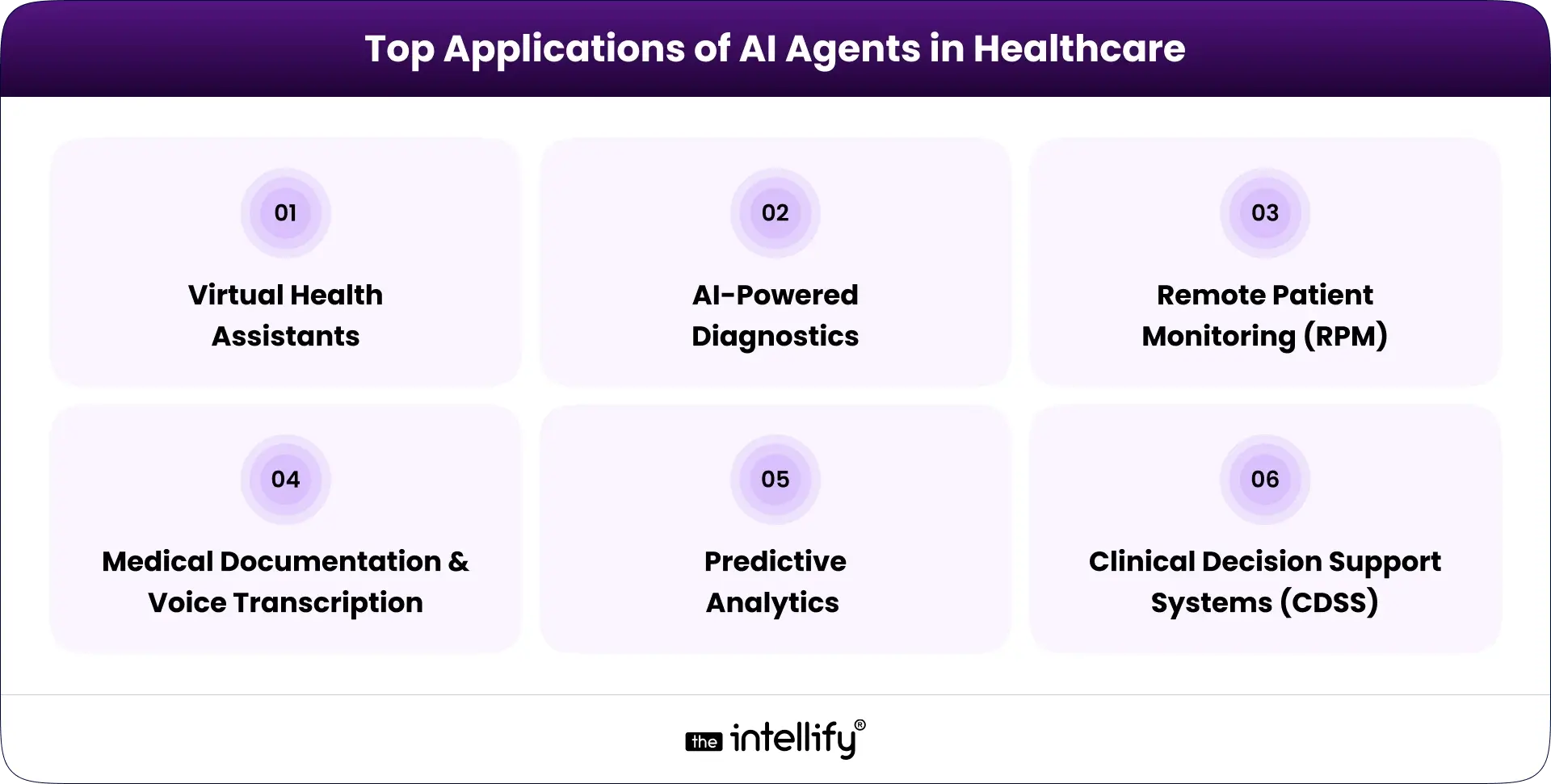
Top Applications of AI Agents in Healthcare

Applications of AI Agents in Healthcare

1. Virtual Health Assistants
AI agents act as front-line support. They help patients make appointments, answer simple questions, and monitor symptoms.

2. AI-Powered Diagnostics
AI agents can read imaging, pathology slides, and genetic data faster and more accurately than doctors.

3. Remote Patient Monitoring (RPM)
AI agents keep an eye on vital signs and let doctors know right away if something is wrong with them when they are connected to wearable devices.

4. Medical Documentation & Voice Transcription
AI agents help doctors by taking notes during consultations and organizing patient records, which reduces administrative workload.

5. Predictive Analytics
AI agents analyze large datasets to forecast disease progression, when people will have to go back to the hospital, or when an epidemic will break out.

6. Clinical Decision Support Systems (CDSS)
These agents help doctors by suggesting diagnostic or treatment paths based on the latest clinical guidelines.


Key Benefits of Using AI Agents in Healthcare

AI agents are very helpful for both patients and healthcare providers. Here are some of the most important benefits:

  • Faster and More Accurate Diagnoses: Real-time analysis of symptoms and medical records.
  • Improved Patient Engagement: 24/7 assistance and continuous health tracking.
  • Reduced Operational Costs: Automating repetitive tasks and improving resource allocation.
  • Personalized Treatment Plans: Tailored care based on patient data and behavior.
  • Scalable Support: AI agents can handle thousands of interactions simultaneously.
  • Data-Driven Insights: Identification of treatment gaps or predictive risk scoring.


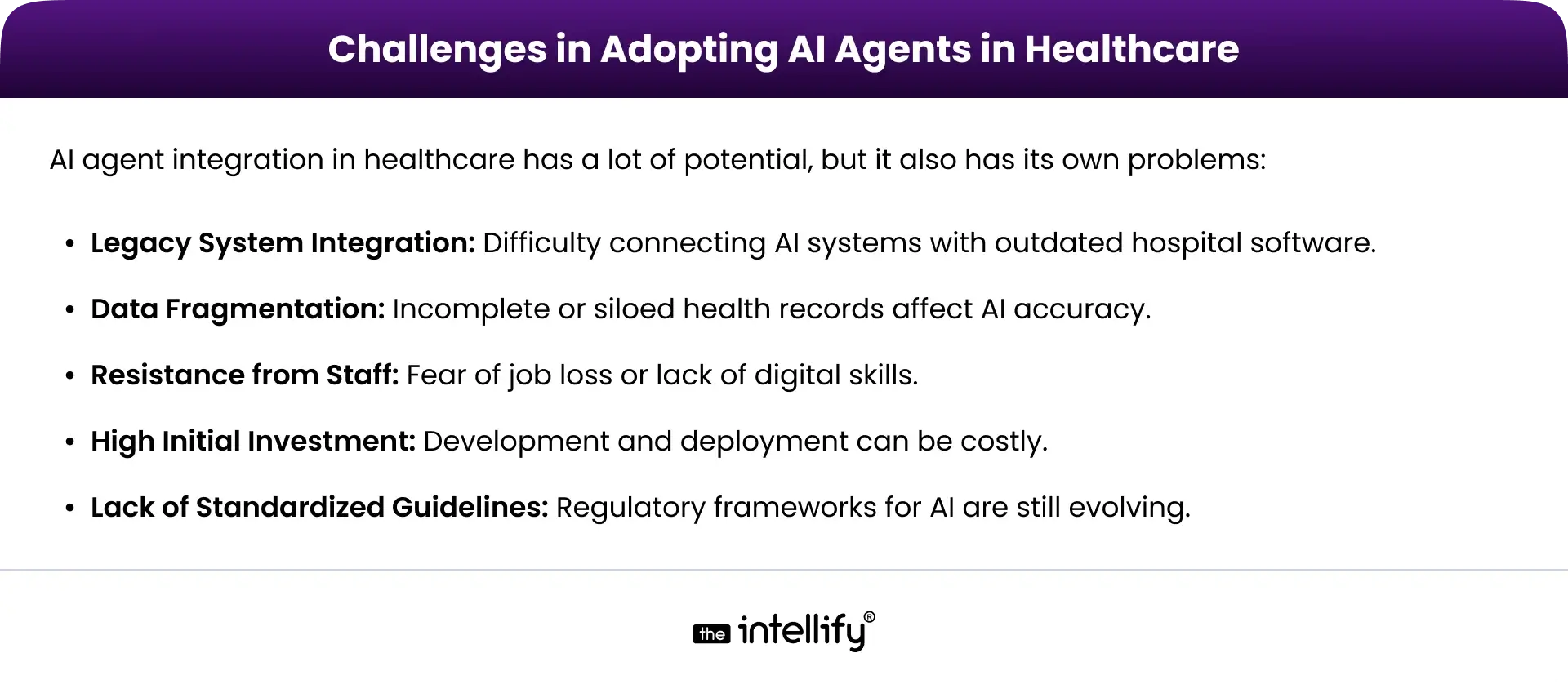
Challenges in Adopting AI Agents in Healthcare

Healthcare AI Agents Use Cases

1. Babylon Health

Their AI-powered chatbot sorts through symptoms and connects users with doctors when needed, which saves time and cuts down on hospital visits.

2. Mayo Clinic

AI tools are used to recognize images and find tumors and heart problems faster and more accurately.

3. IBM Watson for Oncology

This platform analyzes both structured and unstructured patient data to give oncologists treatment options based on evidence.

4. Ada Health

An AI-powered symptom checker used by over 11 million users globally, offering personalized health insights.


Future of AI Agents in Healthcare

Future of AI Agents in Healthcare

The future of AI in healthcare is intelligent, connected, and predictive. AI agents will play a big role in this transformation.
As AI agents evolve, we can expect them to take on even more proactive roles. For example, AI agents could start early intervention protocols by looking at small changes in data patterns before symptoms show up. These steps taken ahead of time could greatly reduce the number of hospitalizations and emergency room visits.

Key Future Trends:

  • Voice-Activated Medical Assistants
  • AI-Powered Digital Twins for Patients
  • Real-Time Disease Surveillance Agents
  • Integration with Augmented Reality in Surgery
  • Fully Autonomous Diagnostic Kiosks in Rural Areas
  • AI Agents Assisting in Mental Health & Behavioral Therapy

As technology upgrades, AI agents will become essential members of the healthcare team, offering scalable, cost-efficient solutions.


Healthcare AI Agents Development Cost

The cost of developing an AI agent for healthcare can vary based on complexity, features, integrations, and compliance needs.

Type of AI Agent Estimated Cost Range
Basic AI Chatbot $10,000 – $30,000
Diagnostic Agent $50,000 – $120,000
Integrated EHR/EMR System $30,000 – $70,000
Voice Recognition Medical Assistant $40,000 – $100,000
Ongoing Maintenance & Compliance $1,000 – $5,000/month

Using open-source libraries, cloud platforms, and modular development methods can help you save money.


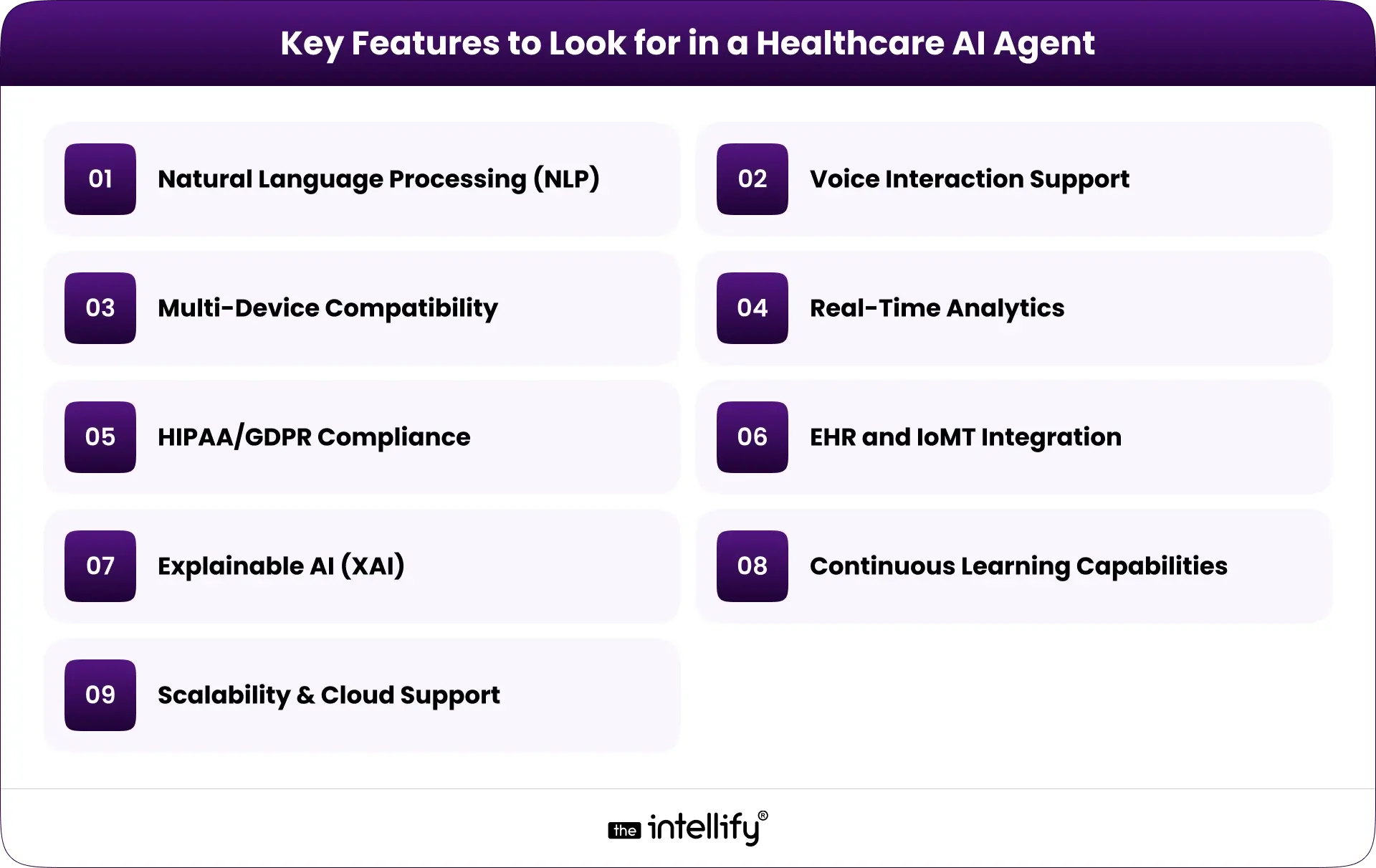
Key Features to Look for in a Healthcare AI Agent

Features of Healthcare AI Agent

When developing or choosing a healthcare AI agent, consider these key features:

1. Natural Language Processing (NLP)

NLP lets the agent understand, interpret, and respond to human language in real time. It’s very important for chatbots, virtual assistants, and voice-activated systems.

2. Voice Interaction Support

As more people use voice technology, voice-enabled agents make it easier for people with vision or mobility problems to use systems.

3. Multi-Device Compatibility

To make sure that patients can interact with the AI agent without any problems, it should work on all devices, including smartphones, desktops, and hospital systems.

4. Real-Time Analytics

Processing data in real time enables timely alerts, accurate predictions, and immediate responses to patient needs.

5. HIPAA/GDPR Compliance

You have to follow the rules for security and privacy. The AI agent must keep personal health information (PHI) safe.

6. EHR and IoMT Integration

Integration with Electronic Health Records (EHRs) and Internet of Medical Things (IoMT) devices makes sure that patient care is consistent and complete.

7. Explainable AI (XAI)

Patients and doctors need to know why AI makes the decisions it does. Explainable AI helps people trust and be transparent.

8. Continuous Learning Capabilities

The agent should be able to learn from new data, outcomes, and people’s feedback to make better decisions over time.

9. Scalability & Cloud Support

The platform should be able to grow with the needs of the organization and be able to run on cloud infrastructure for reliability and flexibility.


Looking for a Trusted Healthcare AI Agents Development Company?

Choosing the right AI Agents development company is important for your AI healthcare success. Look for a company with:

  • Deep domain expertise in healthcare IT
  • Experience with AI/ML model development
  • Compliance with international data regulations
  • End-to-end support from planning to post-launch
  • Proven track record with healthcare clients

The Intellify is a trusted partner for building custom AI solutions for hospitals, clinics, and medtech startups. With a proven history in AI and healthcare integration, we can help you build compliant, scalable, and intelligent agentic systems.

Develop AI Agent for Healthcare

Conclusion

AI agents are quickly becoming an important part of healthcare today. They are very useful for both providers and patients because they help with diagnosis, improve care delivery, and make operations more efficient.
Despite challenges, the adoption of AI agents in healthcare is growing quickly because they can help get better results, save money, and make decisions based on data. Healthcare organizations that invest in AI agents now will be better prepared for the demand of tomorrow.


Frequently Asked Questions (FAQs)

1. What is an AI agent in healthcare, and how does it work?

Answer: An AI agent in healthcare is a smart system that can analyze medical data, understand patient needs, and make informed decisions. It acts like a virtual assistant for doctors and patients, helping with diagnosis, reminders, and support available 24/7.

2. How are AI agents different from traditional chatbots?

Answer: AI agents are far more advanced than basic chatbots. While chatbots follow fixed scripts, AI agents can understand context, learn from data, and make decisions in real time. They offer personalized care and can handle complex medical tasks intelligently.

3. Can AI agents really help in faster and more accurate diagnosis?

Answer: Yes! AI agents scan patient records, symptoms, and test results in seconds, spotting patterns that help doctors make faster, more accurate diagnoses. They don’t replace doctors but offer strong decision support.

4. Are AI agents safe and compliant with healthcare regulations?

Answer: Absolutely. Trusted AI agents follow strict data privacy laws like HIPAA in the U.S. and GDPR in Europe. Always choose AI solutions from providers that ensure full compliance and offer secure integration.

5. What are the top use cases of AI agents in hospitals and clinics?

Answer: Virtual health assistants for patient support

  • AI triage tools for symptom checking
  • Smart scheduling and appointment bots
  • AI diagnosis tools in radiology & pathology
  • Medication alerts and post-op care bots

6. How can my clinic or healthcare startup get started with AI agents?

Answer: Start by identifying your biggest pain point, like appointment delays or patient follow-ups. Then, partner with a trusted AI development company like The Intellify to build or integrate a secure, compliant, and user-friendly AI agent.

How to Develop an Enterprise Chatbot in 2025: The Ultimate Guide

Enterprise chatbots are no longer just a buzzword; they are now necessary tools for businesses that want to improve customer service, automate tasks, and boost employee productivity. In 2025, when AI technologies get better and conversational platforms become easier to use, making an enterprise chatbot will be both a smart move and a way to get ahead of the competition. This complete guide covers everything you need to know, from the different types of chatbots to the cost of development and the most important features. It is useful for CTOs, product managers, and business owners. Let’s get started.


Types of Chatbots You Can Build

Types of chatbots

You need to figure out what kind of chatbot will work best for your business before you start building one. The type has an effect on the cost of development, the complexity, the user experience, and the ability to grow over time.

1. Rule-Based Chatbots

Rule-based chatbots follow a set path. They are best for answering frequently asked questions or handling simple tasks where the user’s goals are clear and limited.

  • Pros: Simple to set up and use, and doesn’t need a lot of training data.
  • Use Case: Basic support questions or automating the HR or IT helpdesk within the company.

2. Keyword Recognition-Based Chatbots

  • These bots know certain keywords that make them do things.
  • A little more flexible than bots that follow rules.
  • Used a lot in e-commerce support, like keeping track of orders and dealing with complaints.
  • Still don’t fully understand the user’s situation.

3. Contextual Chatbots

Contextual bots remember what you’ve said before and get better over time through machine learning. They give answers that are more relevant and tailored to you.

  • Pros: Learns over time and gets better at dealing with complicated situations.
  • Use Case: Virtual assistants for banking and smart customer service agents.

4. Conversational AI Chatbots

These chatbots are very advanced and use complex models for NLP, sentiment analysis, and language understanding. They sound like people talking to each other.

  • Pros: Lots of people are interested, it can grow, and it seems like a person.
  • Use case: chatbots for enterprise knowledge bases and cross-platform support.

5. Generative AI Chatbots

Chatbots that use generative AI, like GPT-4 or Gemini, can make new content and respond to questions in context. They work best for conversations that are open-ended and changeable.

  • Pros: Can change in real time, supports multiple languages, and can make custom outputs.
  • Use case: onboarding new employees, training bots, and tools to help with creative work.


Benefits of Using Enterprise Chatbots

Enterprise chatbots are more than just basic customer service tools; they’re strategic assets that bring in money. Here are some of the best benefits:

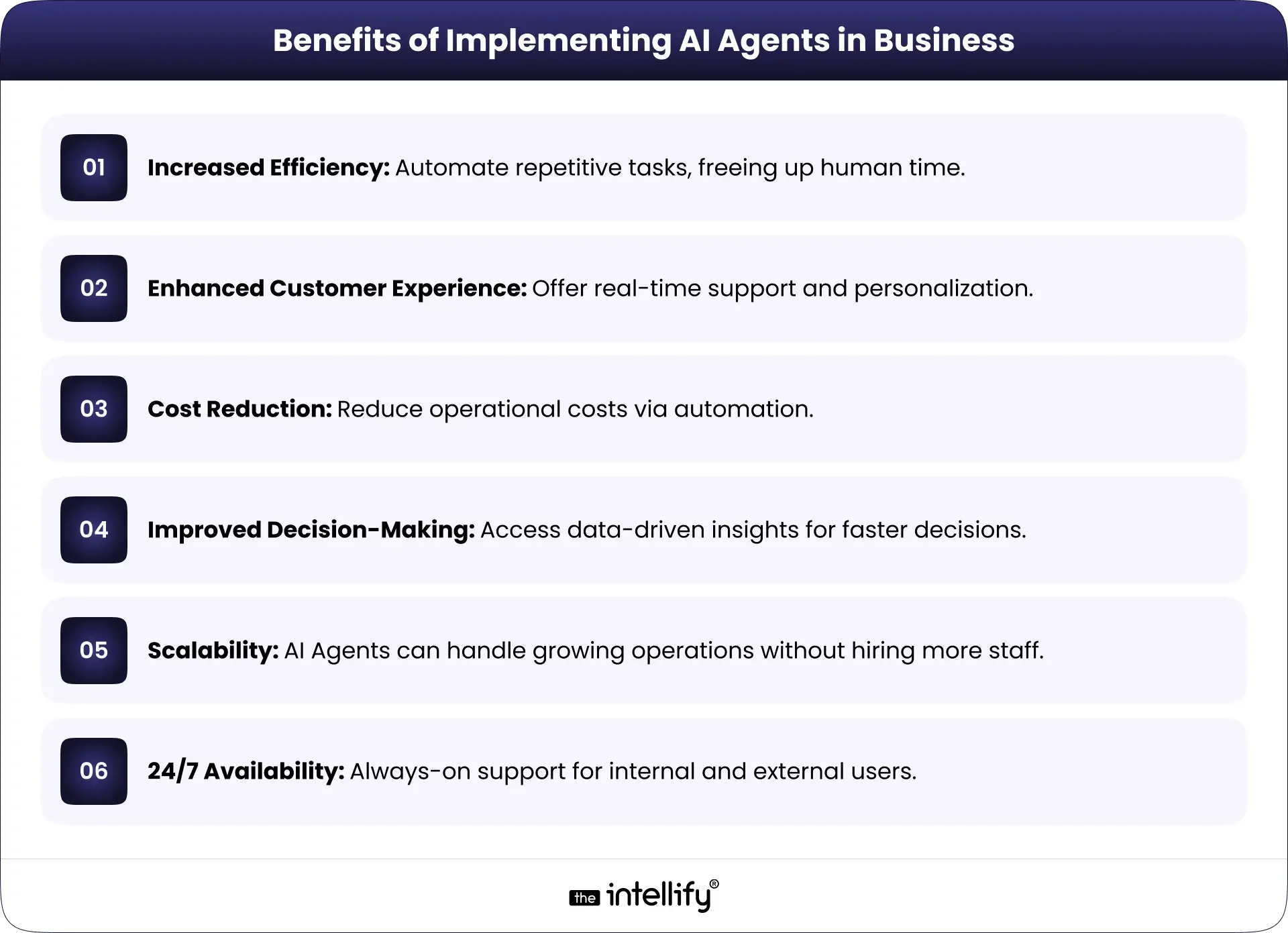
  • 24/7 Availability: Chatbots are always available, unlike human agents.
  • Cost Savings: Automating tasks like answering customer questions, entering data, or processing orders cuts down on the amount of work people have to do and the costs that come with it.
  • Better Customer Experience: Personalized, quick, and consistent answers make customers happier.
  • Increase in productivity: Internal bots help workers quickly find the information they need, which speeds up workflows.
  • Data-Driven Insights: Use information about how users interact with your product to make decisions about sales, marketing, and product development.
  • Scalability: You can easily add more customer support without hiring more people.
  • Data Insights: Interactions with chatbots give us useful information about how customers act.


Difference Between Enterprise Chatbot & Normal Chatbot

Feature Normal Chatbot Enterprise Chatbot
Scope Single-function (e.g., FAQ) Multi-function (HR, Sales, IT, Support)
Purpose Basic Q&A or task handling End-to-end automation & integration
Integration Minimal Deep integration with internal systems
User Base End customers Both employees and customers
Scalability Limited Highly scalable across departments
Data Security Basic Follows enterprise-grade security policies
Intelligence Rule-based or keyword matching Contextual and AI-driven


Popular Enterprise Chatbot Use Cases in 2025

Chatbots are changing how businesses work in many different fields. These are the most common and important ways to use it:

AI Chatbot use cases

1. Customer Service Automation

  • Take care of Tier 1 questions like order status, refund policies, or basic troubleshooting.
  • Decreases wait times and raises CSAT scores.

2. HR Support

  • Make it easier to request time off, ask about payroll, onboard new employees, resume screening, and share policies. (Example: Alris AI)
  • Gives HR staff time to work on strategic tasks.

3. IT Helpdesk

  • Set up automatic password resets, software requests, and status updates for IT tickets.
  • Works with internal tools like Jira, ServiceNow, and others.

4. Sales Enablement

  • It suggests products, makes appointments, and gathers leads.
  • Works with CRM tools to make interactions more personal.

5. Internal Knowledge Base

  • Chatbots that are linked to internal documents help workers find information quickly.
  • Lessens the need to train people by hand or look through papers.

6. Healthcare and Insurance

  • Helps patients make appointments, refill prescriptions, or understand their policy coverage.
  • Lessens the workload of the call center and gets patients and members more involved.

7. E-commerce

Bots help people find products, keep track of their orders, and suggest other options, which increases conversion and retention.

8. Banking and Finance

Secure bots help with questions about accounts, checking if you qualify for a loan, or getting investment advice.

9. Manufacturing

Help with tracking the supply chain, talking to vendors, and getting real-time updates on inventory.


Must-Have Features in an Enterprise Chatbot

Chatbot for enterprise

When making a chatbot for business use, it should be able to do more than just answer questions.

1. Omnichannel Deployment
Should work without problems on WhatsApp, Slack, Teams, and other mobile apps, websites, and intranets.

2. Multi-Language Support
Very helpful for businesses that work around the world.

3. Role-Based Access Controls
Decide what employees or users can ask for or see.

4. System Integration: APIs let you connect CRMs, ERPs, HRMS, ITSM tools, and more.

5. NLP & AI Capabilities
The bot should know what the situation is, what slang means, and what the person wants.

6. Learning & Feedback Loop
Use conversations to keep learning all the time.

7. Analytics Dashboard
Helps you keep track of usage, performance, resolution rate, and more.

8. Security & Compliance
Enterprise-level security with encryption, single sign-on, audit logs, and compliance with GDPR, HIPAA, and other laws.

9. Human Handoff
Ability to switch to a live agent when necessary.

10. Custom Workflows
Support for complicated flows like approvals, escalations, or calls from other people.


How to Choose the Right Enterprise AI Chatbot Development Company

Choosing the right AI chatbot development company is very important. Here are some things to think about:

1. Domain Expertise
Pick a company that has worked in your field before, like healthcare, retail, or finance.

2. AI and NLP Capabilities
Make sure they use the latest LLMs and have worked with NLP engines like OpenAI, Google Dialogflow, Microsoft Bot Framework, and others.

3. Integration Support
Find out if they can add the bot to your tech stack, which might include CRMs, HRMS, ERPs, and other tools.

4. Customization Capability
In the business world, one size doesn’t fit all very often.

5. Technology Stack
They should know how to use Dialogflow, Rasa, Microsoft Bot Framework, GPT-based LLMs, and other similar tools.

6. Scalability Support
Make sure the solution can handle growth, like more users, channels, and functions.

7. Post-launch support
It’s very important to keep getting updates, training, and performance improvements.

8. Compliance Awareness
Understanding data privacy, rules that apply to specific industries, and best practices for putting things into action.


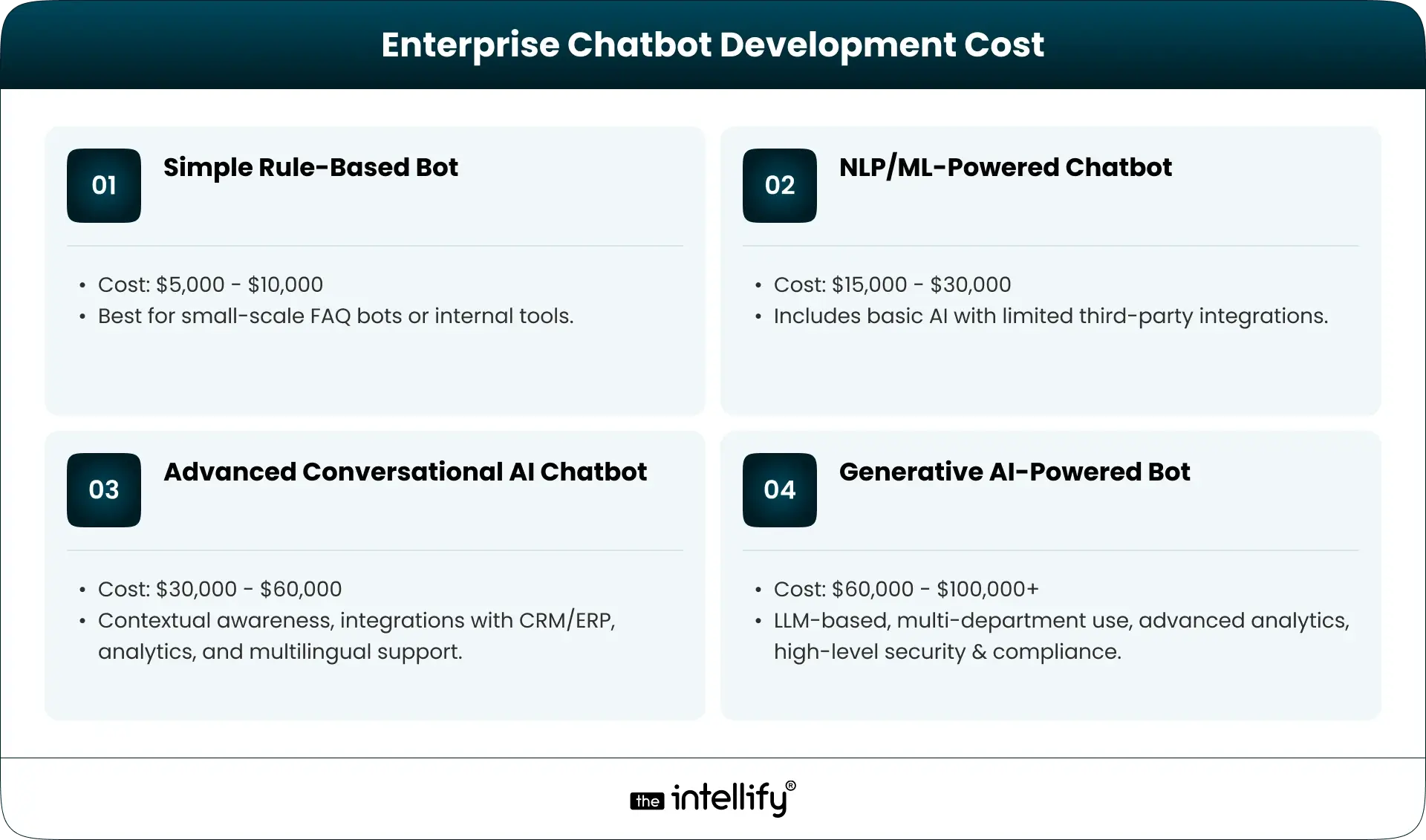
Cost of Chatbot Development for Enterprises in 2025

The price depends on how well it works, what technology it uses, how easy or hard it is to use, and how many integrations it has.

Chatbot development cost

Factors affecting cost:

  • Custom design and UX
  • Language support
  • Voice integration
  • API integration (Salesforce, SAP, Zendesk)
  • Data storage and hosting (cloud/on-premise)

Hidden costs to consider:

  • Training and fine-tuning AI models
  • Continuous support & maintenance
  • Licensing for NLP engines (e.g., OpenAI, Google Cloud)


Develop Chatbot for your Enterprise


Final Thoughts

In 2025, enterprise chatbots will no longer just be tools for customer service; they will also be tools for business strategy. AI and automation-powered chatbots are the best way to scale up and work more efficiently, whether you want to improve customer service, streamline internal processes, or boost sales.

Making an enterprise chatbot isn’t a project that works for everyone. It needs careful planning, the right technology stack, and a software development partner who knows what your business wants to achieve. If you do things right, your business chatbot can be a digital coworker 24 hours a day, 7 days a week, ready to help users, increase productivity, and give you a real return on your investment.

If you want to stay ahead in a market that changes quickly, now is the time to invest in making enterprise chatbots. The sooner you start, the sooner you’ll be able to see how AI-powered automation can help your business.


FAQs About Enterprise Chatbot Development

Q1: How long does it take to make a chatbot for a business?
Most of the time, it takes 6 to 12 weeks, depending on how complicated it is, what integrations are needed, and how much testing is needed.

Q2: Can enterprise chatbots completely replace human agents?
Not completely. Even though they make things easier, complex or emotional questions still need a person to answer them.

Q3. Do I need a big IT team to take care of the chatbot?
No. Even a small tech team can handle it with managed services and easy-to-use dashboards.

Q4: Which industries get the most out of enterprise chatbots?
Banking, healthcare, retail, manufacturing, human resources, and insurance are the most common users.

Q5. What can I do to make sure the chatbot is safe?
Use encryption, secure APIs, SSO, and audit logs, and make sure you follow GDPR or HIPAA.

Q6. What are the differences between chatbots that can have conversations and those that can create new things?
With some context, conversational bots follow structured flows. Generative AI bots use LLMs to make responses that change and go beyond set scenarios.

Q7. Is it possible to change my current chatbot into a generative AI model?
Yes. A good development partner can use LLMs to rebuild or improve your bot while keeping important integrations.

Top 15+ AI Agents Use Cases for Business in 2025

AI Agent Overveiw

AI agents are no longer something that will happen in the future; they are already here, changing quickly, and making modern business work better in many fields. AI agents are helping businesses work smarter and more efficiently by automating customer service, managing finances, and changing the way things are made.

This blog goes into great detail about AI agents, including how they work, the different types, the top 15+ real-world business use cases across industries, the problems and benefits they bring, and how businesses can start their AI journey.


Different Types of AI Agents

Different Types of AI Agents

AI agents are different from each other in how they take in information, make choices, and interact with the world around them. These are the main kinds of AI agents:

1. Simple Reflex Agents

  • Do what you think is right based on what you see right now, without thinking about the bigger picture.
  • Example: A basic chatbot that replies to specific keywords.

2. Model-Based Reflex Agents

  • Use an internal model to make sense of the world and react based on what you’ve seen and heard in the past and present.
  • Example: Virtual assistants tracking user preferences.

3. Goal-Based Agents

  • Think about the different ways you can reach a certain goal and make a choice.
  • Example: AI used in autonomous delivery planning.

4. Utility-Based Agents

  • Look at a number of options and decide which one has the most expected utility (value).
  • Example: AI can be used to set prices that change based on how many people want something.

5. Learning Agents

  • Learn from data all the time and get better over time.
  • Example: AI agents that adapt their performance through feedback loops.


How AI Agents Operates

AI agents interact with their surroundings, collect information, understand it, and then make smart choices or suggestions. This is how the main features usually work:

  • Perception: Agents use sensors or APIs (like customer messages or sales trends) to get information.
  • Decision-Making: Agents decide what to do next based on programmed logic or trained ML models.
  • Action: They do things like answer a question, update records, or let a person know.
  • Learning: Advanced agents change based on how well they do, what users say, or new information.

Some of the technologies that make AI agents possible are:

  • Machine Learning (ML)
  • NLP, or Natural Language Processing
  • RPA, or Robotic Process Automation
  • Learning Deep
  • Vision for Computers


Use Cases of AI Agents in Business

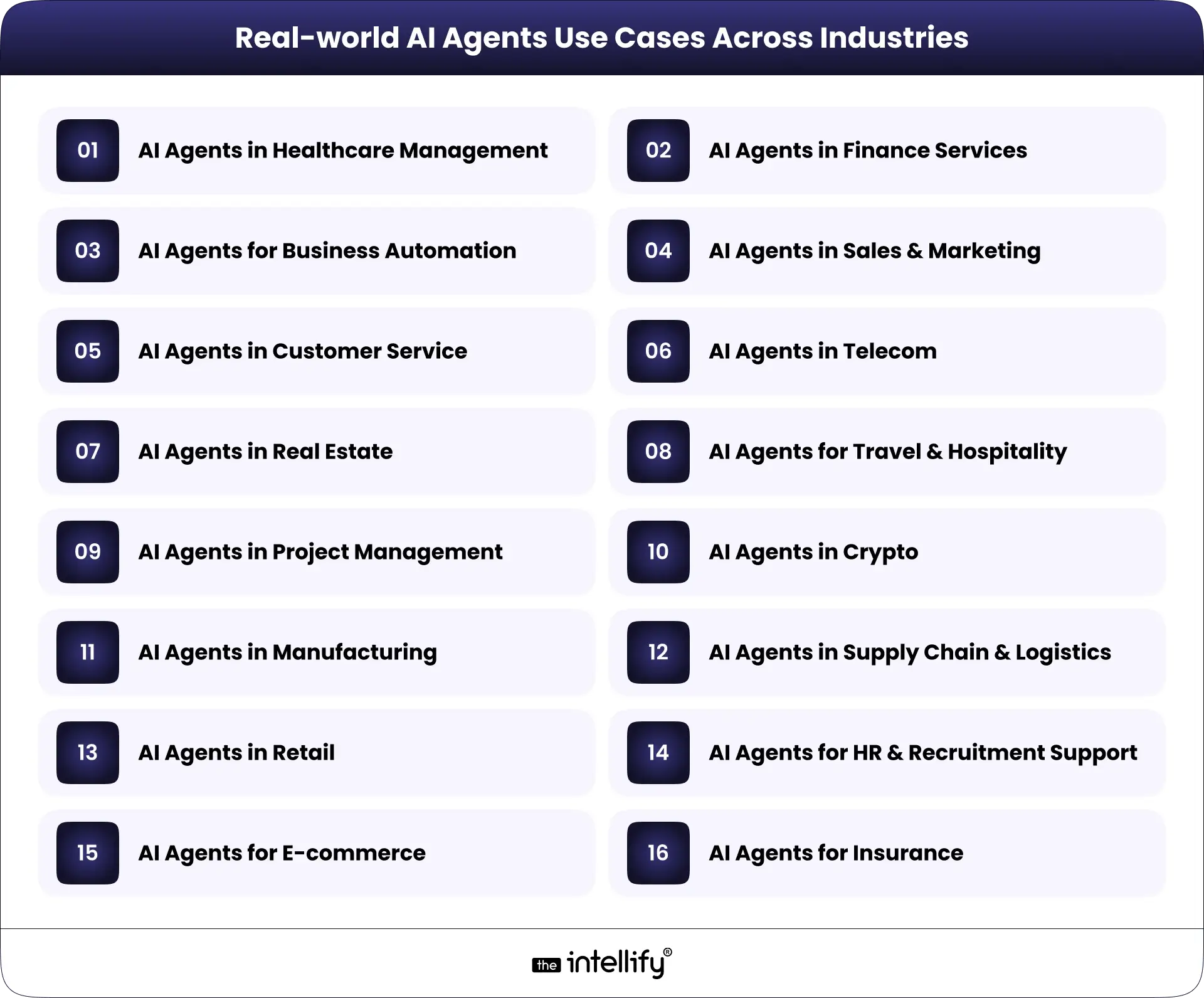
AI agents are deployed across industries, improving efficiency, productivity, and user satisfaction. Here are 15+ practical and powerful use cases:

AI Agent Use Cases

1. AI Agents in Healthcare Management

Healthcare providers use AI agents for better patient engagement, predictive diagnostics, and operational efficiency.

  • Virtual assistants for appointment scheduling and medication reminders
  • Predictive AI for disease diagnosis
  • Remote monitoring of patient vitals via smart AI agents
  • NLP-based chatbots answering medical queries

These AI agents in healthcare reduce administrative workload and improve patient experiences.
Example: AI agents like Babylon Health help in triage, virtual consultations, and reducing hospital visits.


2. AI Agents in Financial Services

Banks, insurance companies, and fintech platforms leverage AI agents for fraud detection, credit risk analysis, customer service, and investment advice.

  • Real-time anomaly detection to flag suspicious transactions
  • Chatbots for 24/7 banking support
  • Robo-advisors offering customized investment portfolios
  • Loan approval automation based on financial history and risk score

Example: AI agents in PayPal help flag fraudulent transactions faster than traditional systems.


3. AI Agents for Business Process Automation

Companies are automating repetitive internal workflows using AI agents to reduce human errors and save time.

  • Invoice processing bots
  • Automated report generation
  • Smart document classification and tagging
  • Workflow management across HR, finance, and procurement

Key benefits: Increased productivity, faster turnaround time, and cost reduction.


4. AI Agents in Sales & Marketing

Marketing teams deploy AI agents for data-driven insights and hyper-personalized campaigns.

  • AI for customer segmentation and targeting
  • Predictive analytics for lead scoring
  • Automated email and SMS campaigns
  • Content personalization based on user behavior

Sales teams use AI for pipeline forecasting and conversational selling via AI-powered assistants.

Example: Drift and Conversica’s AI sales agents improve follow-ups and conversion rates.


5. AI Agents in Customer Service

Customer service is one of the most mature use cases for AI agents. With the rise of AI voice agents, businesses provide 24/7 multilingual support.

  • AI voice bots answering common customer questions
  • Omnichannel AI chatbots on websites, social media, and apps
  • Smart ticket categorization and routing
  • Sentiment analysis for customer mood detection

These agents drastically reduce wait times and improve satisfaction.


6. AI Agents in Telecom

The telecom sector uses AI agents to streamline network management and improve service reliability.

  • Predictive maintenance of telecom infrastructure
  • Smart agents resolving technical queries
  • Billing automation and fraud detection
  • Personalized plan recommendations for users

Example: Vodafone uses AI agents for customer complaint resolution.


7. AI Agents in Real Estate

Real estate firms are adopting AI agents for client engagement and operational insights.

  • AI chatbots responding to property inquiries
  • Smart agents scheduling property tours
  • AI for property valuation based on real-time market data
  • Intelligent CRM integrations for lead nurturing

Key benefit: Streamlined sales funnel and improved customer interaction.


8. AI Agents for Travel & Hospitality

AI is reshaping how travelers book, plan, and experience travel.

  • Travel booking assistants
  • AI chatbots offering multilingual support
  • AI-curated travel itineraries based on preferences
  • Price tracking and alerts

Example: Expedia uses AI to automate travel booking and suggestions.


9. AI Agents in Project Management

AI agents optimize project delivery, reduce risks, and improve collaboration.

  • Automated task assignment and scheduling
  • Time tracking bots
  • Risk prediction and mitigation alerts
  • AI assistants summarizing project status updates

Benefit: Managers can focus on strategy while agents handle routine coordination.


10. AI Agents in Crypto

Crypto AI agents assist investors in analyzing volatile markets and automating transactions.

  • Real-time trading bots
  • Market sentiment analysis from social data
  • Crypto portfolio rebalancing tools
  • NFT value prediction models

Example: 3Commas and Pionex offer AI crypto bots for trading optimization.


11. AI Agents in Manufacturing

Manufacturers use AI agents to increase uptime, reduce waste, and streamline processes.

  • Predictive maintenance of machinery
  • Real-time quality control and defect detection
  • Production scheduling optimization
  • AI-powered safety monitoring systems

Result: Reduced downtime, improved product quality, and higher ROI.


12. AI Agents in Supply Chain & Logistics

These agents bring agility and efficiency across supply networks.

  • Inventory prediction and replenishment bots
  • Route optimization for logistics
  • Warehouse automation with vision-enabled robots
  • AI for demand forecasting

Example: DHL uses AI to optimize delivery routes and customer communication.


13. AI Agents in Retail

AI agents transform the shopping experience, both online and in-store.

  • Personalized product recommendations
  • Virtual try-on AI assistants (clothing, makeup, eyewear)
  • In-store navigation bots
  • AI-powered visual search

Example: Sephora uses virtual assistants for product selection and virtual try-ons.


14. AI Agents for HR & Recruitment Support

HR departments leverage AI for better talent management and employee satisfaction.

  • Resume screening bots
  • Virtual agents for employee onboarding and offboarding
  • Leave application and tracking agents
  • Company policy and benefits information retrieval

Example: Alris AI simplifies employee onboarding and policy retrieval through a conversational interface like Agentic AI & chatbots which eases HR workload.
Result: More efficient hiring and improved employee experience.


15. AI Agents for E-commerce

Online retailers use AI to boost conversions, retention, and experience.

  • Smart chatbots for product discovery
  • Cart abandonment recovery agents
  • Voice shopping assistants
  • Dynamic pricing optimization

Benefit: Higher conversion rates and better customer satisfaction.


16. AI Agents in Insurance

The insurance industry is digitizing processes with AI.

  • AI agents for claim intakes and validation
  • Fraud detection bots
  • AI for underwriting and risk analysis
  • Virtual policy assistants

Example: Lemonade uses AI agents for instant claims approval and customer support.


Benefits of AI Agents in Business


Challenges of Adopting AI Agents

  • Data Privacy and Security: Making sure that customer data is safe.
  • Bias in Algorithms means that biased data can lead to outcomes that are not fair or useful.
  • High Initial Costs: Making custom AI can cost a lot of money.
  • Integration Complexities: making sure it works with the tech stacks that are already in place.
  • Change Management: Teaching workers and changing the culture.


Real-World Examples – Case Studies

Alris AI: Alris AI is a smart AI platform that helps HR teams with onboarding, leave requests, IT support, and questions about company policies to make the experience better for employees.

AirAsia: Uses AI agents to help with booking, ticketing in multiple languages, and real-time updates, which cuts down on the time customers have to wait.

HDFC Bank used AI voice bots to answer more than half of customer questions, which sped up service and cut costs.

Amazon uses AI agents to make smart product suggestions, automate warehouses, and plan deliveries.


The Future of AI Agents

Future of AI Agents

AI agents are getting better at talking to people, being independent, and changing. Important trends that will shape the future:

  • Multimodal AI Agents: Able to handle text, voice, pictures, and videos as inputs
  • Agent Collaboration: When several agents work together to reach a difficult goal
  • Human-in-the-loop AI: Using AI to make things faster while still using human knowledge
  • Domain-Specific Agents: Made for fields like law, farming, and education

As more people use AI, it will be built into all business software and user interactions.


How to Invest in AI Agents?

  1. Identify Use Cases: Start with a high-impact area like sales or support.
  2. Use No-Code or Low-Code Platforms to make deployment faster with little work.
  3. Pilot First: Do a pilot program before you grow.
  4. Work with AI Development Experts: Find a reliable company to help you make solutions that are just right for you.


Looking for an AI Agent Development Company?

The Intellify is a leading AI agent development company that helps startups and enterprises build intelligent digital assistants and agents. From AI voice bots to advanced autonomous systems we deliver custom solutions tailored to your business goals.

  • Experienced in multiple industries
  • Proven track record in AI automation
  • Scalable, secure, and future-ready solutions


Develop AI Agent CTA


Last Thoughts

AI agents are more than just software; they are digital coworkers that help make better decisions and run things more smoothly. Companies that put money into AI agents now will have an advantage over their competitors, be more productive, and be better ready for the changing business world of the future.
AI agents can make every part of your business work better, whether it’s HR, sales, manufacturing, or customer service. Work with professionals like The Intellify to create AI-powered systems that are always available for your business.

Conversational AI Chatbots: Smarter Communication for Business Growth

The days when chatbots could only respond to simple questions are long gone. Businesses are now using conversational AI chatbots in 2025 to interact with customers and employees more intelligently and humanely. These chatbots using NLP (Natural Language Processing), ML (Machine Learning), and AI algorithms are more than helpful, they are transformational.

Along with covering the most powerful conversational AI chatbots, this blog outlines their best use cases and what competitive features a business needs to stay relevant. Furthermore, we aim to clarify several important differences such as chatbot and conversational AI, and chatbots and AI assistants for customer and employee service experiences.


What is a Conversational AI Chatbot?

Conversational AI Chatbots use cutting-edge software algorithms to replicate human dialogue at an advanced level. Unlike more traditional bots which follow a command-driven logic, conversational AI chatbots leverage NLP and ML to understand user intents and context greatly enabling interaction.

Key Capabilities:

  • Understanding spoken and written slang
  • Extract useful information based on previous interactions
  • Issue responses from multiple platforms (websites, applications, WhatsApp, etc.)
  • Perform several tasks like responding to FAQs, processing returns, handling appointments and more.

Such forms of chatbots have the ability to learn and evolve over time, which adds more value to business perspectives.


Important Features to Bear in Mind for a Conversational AI Chatbot in 2025

The best chatbots that are powered by conversational AI systems work like specialized employees because they have more integrated functions than just chatting. Below is a list of the most important ones:

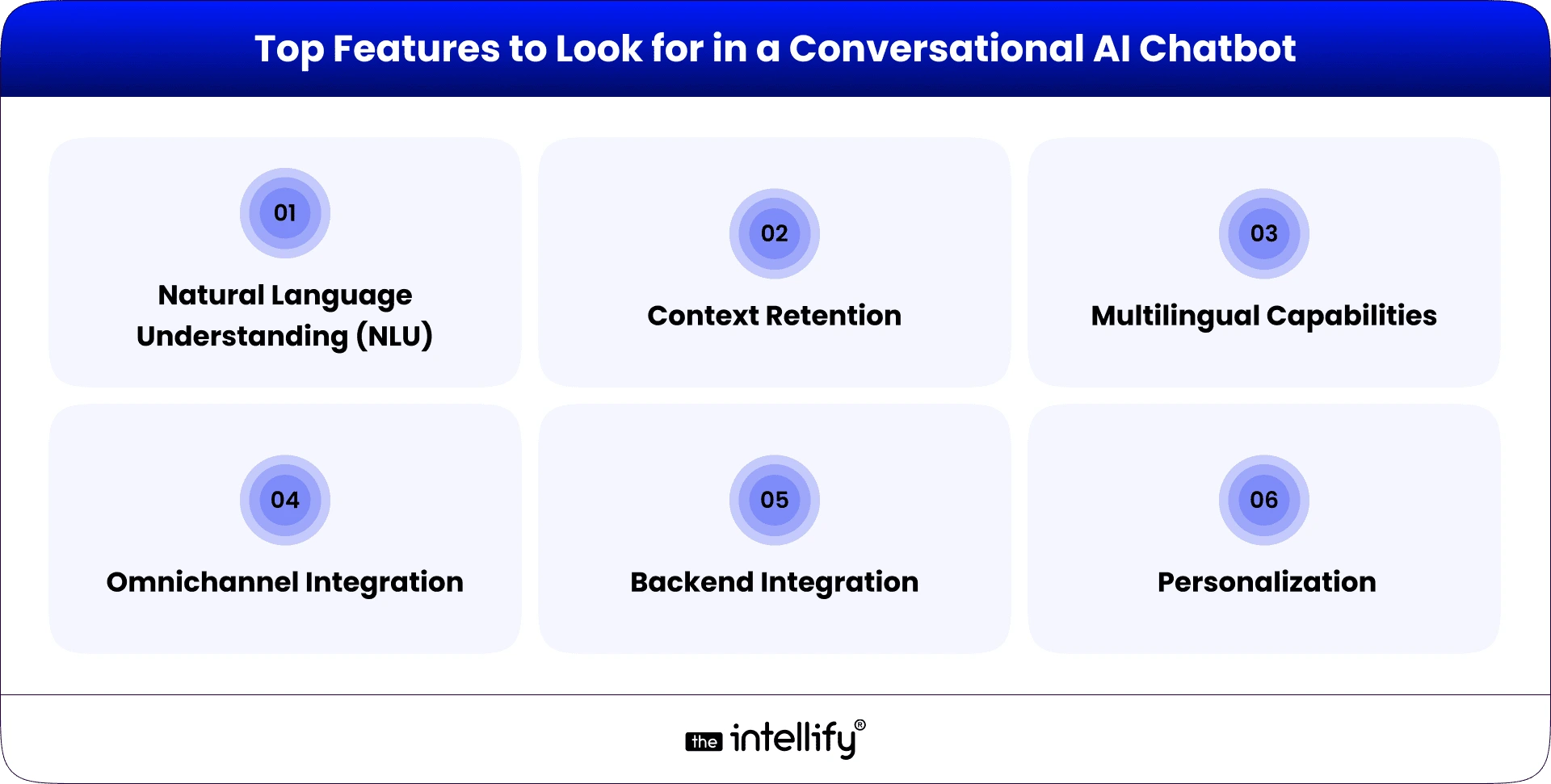
Top Features of Conversational AI Chatbot

1. Natural Language Understanding (NLU)

NLU enables the chatbot to capture context-dependent phrases and the users’ feelings like emotion and tone. Without such capabilities, intelligent conversations would not be possible.

2. Context Retention

Keeps logged conversation history so users’ prior inputs can be remembered and sensible replies can be given.

3. Multilingual Capabilities

Interacts with users in their native languages which aids users and expands business reach to address target audiences from all corners of the world.

4. Omnichannel Integration

Websites in addition to mobile apps, social networks, WhatsApp, and Slack are included as channels where the bots can be deployed.

5. Backend Integration

Gets linked with auxiliary management systems such as CRMs, stocks, human resource software, et cetera, to perform real time actions.

6. Personalization

Increases relevance and meaning during conversations through user profiles, activities, or past interactions.


Why are Conversational AI Chatbots Essential in 2025?

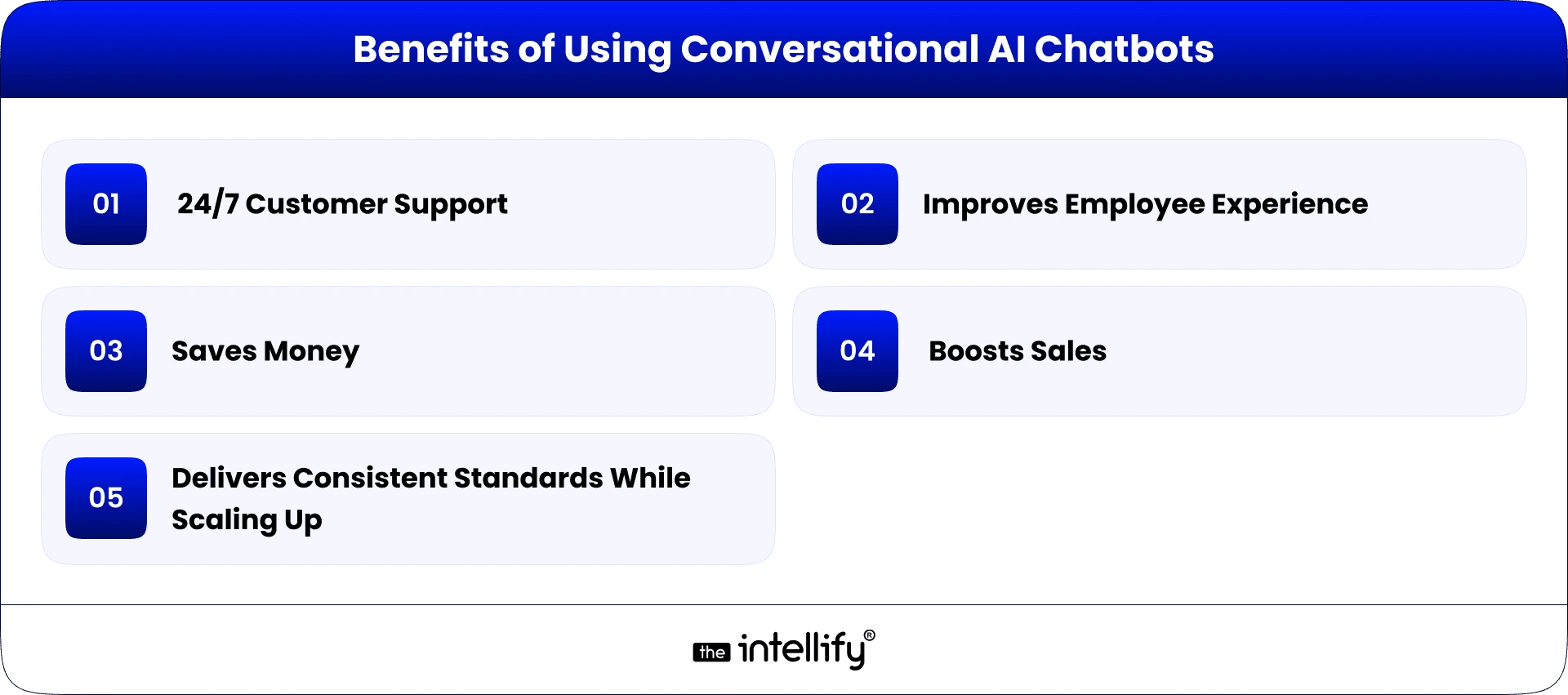
Benefits of Using Conversational AI Chatbots

1. 24/7 Customer Support

Chatbots powered by AI are available at all times. These systems work in all time zones and can respond to users instantly improving user satisfaction.

2. Improves Employee Experience

Employees can be relieved from IT matters like password resetting and leave balance checking as these can be done by HR chatbots. More challenging and strategic roles can then be assigned to these humans.

3. Saves Money

Reducing complex queries and workflows within a business can lead to an efficient decrease in operational costs.

4. Boosts Sales

Sales Closing Conversational AI helps in product recommendations and providing checkout assistance which helps in reducing cart abandonment.

5. Delivers Consistent Standards While Scaling Up

AI chatbots have the ability to hold numerous interactions at the same time and maintain high standards of performance and quality.


Best Use Cases of AI Conversational Chatbots Across Different Industries

1. E-commerce

  • Proposing items for selling.
  • Order tracking.
  • Handling returns and complaints.

2. Banking & Financial Services

  • Fulfil requests for account related queries
  • Notifications of account of suspiciously fraudulent activities
  • Pre-qualification checks for loan and credit card applications

3. Healthcare

  • Managing appointment booking
  • Assessing possible health concerns
  • Providing follow-up care post appointment

4. Travel And Hospitality

  • Hotel and flight bookings
  • Detailed travel planning suggestions
  • Check-in and update notifications

5. Education

  • Providing data and facts about the offered courses
  • Assisting with the admissions procedure
  • Tracking academic activities and performance of an individual

6. Human Resources and Internal Assistance

  • Recruiting and training new staff
  • Requests regarding organizational rules and policies
  • Managing the calendar for absences and leave

Curious how a real-world AI chatbot works?
Check out how we built an intelligent AI CareBot that’s transforming patient engagement and virtual assistance in real healthcare environments.
👉 Read the AI Carebot Success Story.


AI Chatbots and Employee Experience

AI chatbots are not only changing the process of handling customers, but will also change the rest of the internal processes. Now, HR and IT departments enhance experience of employees by:

  • Answering frequently asked questions perpetually and instantly
  • Guide through onboarding paperwork
  • Streamlining non-critical tasks like expense reimbursement, claiming expenses, or securing access to programs through robotics and other automation technologies

Support is instant and responses are provided in no time making ai chatbots greatly helpful.


Difference Between Chatbot and Conversational AI

Feature Conversational AI Chatbot Rule-Based Chatbot
Understands Natural Language Yes No
Learns from Interactions Yes No
Handles Complex Queries Yes Limited
Context Awareness High None
Multichannel Support Yes Usually limited


Understanding Basic Queries is the Limit for Rule Based Chatbots: An Explanation
A rule-based chatbot can only answer basic and straightforward questions. As opposed to a conversational AI chatbot which uses natural language processing (NLP) and machine learning to respond to nuanced questions.


Conversational AI Chatbot vs AI Assistants

Conversational AI Chatbot vs AI Assistants

At a first glance, a Conversational AI Chatbot and an AI assistant appear the same, however they significantly differ in application and functionality.

Conversational AI Chatbots:

  • Text driven with voice capabilities.
  • Scaled for business communication.
  • Provide automation for enterprise processes and respond to thousands of queries simultaneously.

AI Assistants (For Example: Siri, Alexa):

  • Voice activated and device specific.
  • Personal task reminders, alarms, and music playback aid.
  • One-on-one and consumer driven interactions.

Use case comparison:

Attribute Conversational AI Chatbot AI Assistant
Target User Customers & Employees Individual Users
Scalability High Low
Primary Use Business Support Personal Tasks
Channels Omnichannel Limited to Devices

In summary, while AI chatbots are aimed towards scaling business communication and service, AI Assistants focus on aiding individual users.


How To Implement a Conversational AI Chatbot

1. Identify Your Use Case

Decide if you need a chatbot for customer service, an employee helpdesk, lead generation, or other use cases.

2. Choose The Right Platform

Look for a chatbot with natural language processing (NLP) capabilities that is easy to integrate and offers customization.

3. Design The User Journey

Create intuitive and supportive conversational steps.

4. Train The Bot

Provide FAQs, pertinent documents, and chat histories to refine the AI’s understanding of the users.

5. Launch and Verify

Activate the AI Companion and evaluate specific improvements to the chatbot based on the captured performance metrics.

6. Continuous Optimization

Utilize the feedback offset against the quantifiable goals to refine the AI-driven interactions.


Conversational AI Trends to Watch in 2025

Understanding these trends will help businesses stay competitive:

Voice-Enabled Chatbots

With an increasing number of users engaging vocally, chatbots now require to respond using spoken language.

Emotion Recognition

Bots are sophisticated enough to detect the user’s mood and adapt their tone.

Personalized Conversations

Leveraging data from CRMs, bots tailor conversations based on prior interactions with the user.

Low Code/No Code Deployment

Staff without technical expertise can build and manage bots through visual editors, resulting in increased bot adoption.

AI + Analytics Integration

Businesses analyze chatbots’ customer service interactions to enhance customer experience strategies and refine business decisions.

Sector Specific Chatbots

More companies focus on developing custom chatbots for specialized sectors like healthcare, fintech, education, and logistics.


Why Choose The Intellify For Your Conversational AI Chatbot?

The Intellify focus on intelligent, secure, scalable, and customizable solutions, framing the development of conversational AIs around the user’s business model.

What You Get:

  • Makes you proficient in AI development for over 10+ years
  • AI Chatbots that are designed specifically for your business operations are intuitive and easy to use.
  • CRMs, ERPs, and Apps are integrated with ease and require next to no effort.
  • Accessible via Mobile, Web, WhatsApp, and other channels.
  • Protecting your privacy and compliance policies.

Enterprise, SME, or a startup, our user-friendly and advanced algorithm sophisticated conversational AI chatbots would engage users and employees effortlessly.


Conversational AI chatbot solution


Final Thoughts

By 2025, businesses need to focus on applying AI technology-powered Conversational Power Chatbots to automate and enhance customer support, internal query automation, or sales processes.
Always improving business practices today will ensure a solid competitive advantage tomorrow. In this age of rapid technological advancement, no one with access to solutions should hesitate to adopt them.

View
Case Study